How to Use Hall Effect Transducer for Accurate Sensing Applications?
In the realm of accurate sensing applications, the Hall Effect Transducer has become a vital tool. According to Dr. Lisa Thompson, a renowned expert in sensor technology, “The precision of Hall Effect Transducers can transform measurements in industry.” This statement encapsulates the profound impact of these devices on various sectors, including automotive and electronics.
Hall Effect Transducers work by converting magnetic field changes into voltage changes. This mechanism allows for precise measurements of current and position. However, many users still struggle with understanding the full potential of these sensors. Misapplications can lead to inaccurate data. Users should carefully consider their specific needs and the environment where these transducers will operate.
Understanding the nuances of Hall Effect Transducers is crucial. Each application requires a tailored approach, taking into account factors such as temperature and magnetic field strength. There is a learning curve involved, yet the rewards are immense. With proper use, these sensors can enhance efficiency and accuracy in countless applications. Users must ponder the best practices and requirements.

Overview of Hall Effect Transducers and Their Principles
Hall Effect transducers are essential components in various sensing applications. They operate on the principle of the Hall Effect, where a magnetic field interacts with charges in a conductor. This interaction creates a voltage perpendicular to both the magnetic field and the current flow. This voltage can be measured accurately to determine changes in magnetic fields, making Hall Effect transducers vital in automotive and industrial applications.
These devices are compact and can be integrated into different systems. They provide real-time measurements with high precision. However, some challenges exist. Environmental factors can influence their readings. Temperature variations or magnetic noise may affect accuracy. Calibration is crucial for reliable performance.
It's important to consider these factors when designing systems using Hall Effect transducers. Regular maintenance and recalibration help ensure that the measurements remain consistent over time. This complexity adds an extra layer of consideration for engineers and developers.
Types of Hall Effect Transducers Used in Sensing Applications
Hall effect transducers are crucial in various sensing applications. They convert magnetic fields into electrical signals. There are different types of these transducers, each serving specific functions. Understanding their variations can enhance sensing accuracy.
One common type is the linear Hall effect sensor. This sensor responds to magnetic fields linearly. It provides precise measurements in applications like speed detection.
Another is the switch-type Hall effect sensor. This sensor operates as a digital switch, ideal for detecting position changes. It can be found in safety devices and automotive systems.
There are also three-dimensional Hall effect sensors. These sensors measure magnetic fields in all directions. They are beneficial in robotics and advanced navigation systems. However, their complexity can sometimes lead to challenges in integration. Users must ensure they have the necessary knowledge for
proper implementation. Accurate calibration is essential for optimal performance.
Choosing the Right Hall Effect Transducer for Specific Needs
Choosing the right Hall Effect transducer is crucial for achieving accurate sensing applications. First, consider the measurement range required. Some applications need high sensitivity, while others may prioritize speed. Analyze your specific needs. For instance, in low-current applications, a transducer with a narrower range could suffice. However, high-efficiency systems will require broader sensing capabilities to function optimally.
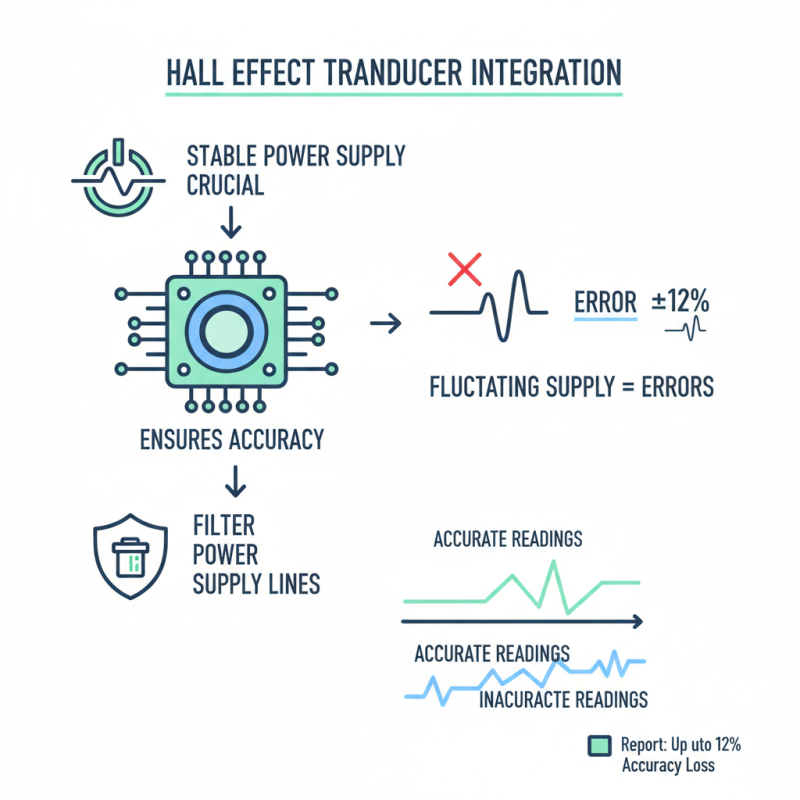
Next, evaluate the type of Hall Effect transducer. There are linear and switching versions. Linear transducers provide a continuous output, ideal for precise measurements. In contrast, switching transducers deliver on or off signals. This can be simpler, but can lead to missed nuances. Also, power supply needs vary. Some devices operate on low voltage, while others require more power. Understanding these requirements helps select a fitting option.
Lastly, the thermal stability of the transducer is often overlooked. If a sensor operates in extreme temperatures, issues may arise. Sometimes, performance degrades under high heat. Test under expected conditions. Don’t assume all transducers handle heat well. These factors may reflect on your final results. Consider flexibility too. Is the transducer easy to integrate into existing systems? As you weigh these aspects, success lies in careful evaluation.
Best Practices for Calibration and Accuracy Improvement Techniques
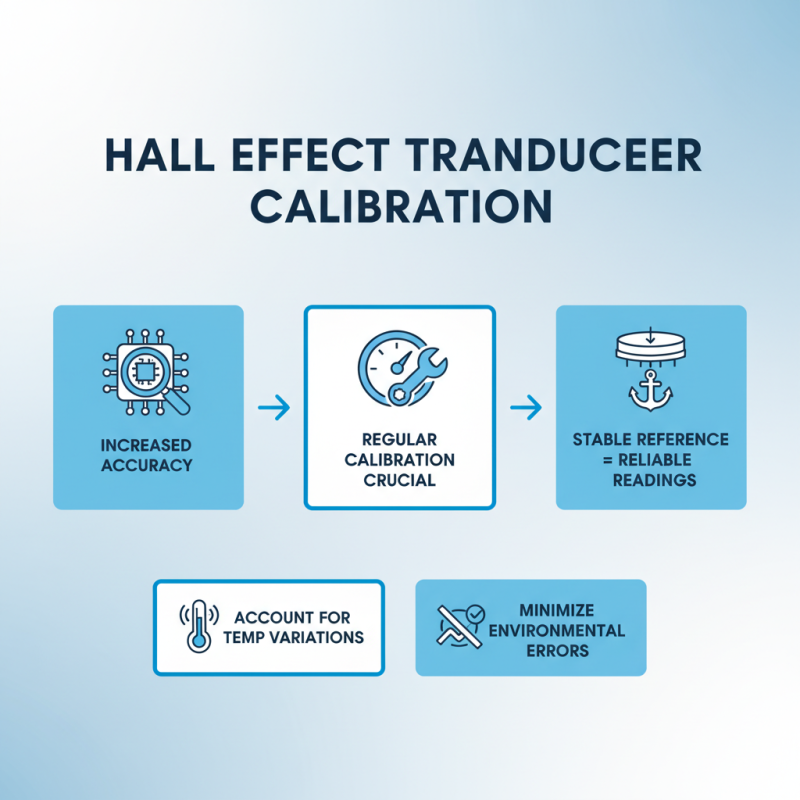
Using a Hall Effect transducer can significantly enhance the accuracy of sensing applications. For optimal performance, calibration is crucial. Regularly calibrating the sensor ensures reliable readings. Use a stable reference for calibration. This minimizes errors caused by environmental factors. Remember to account for temperature variations. These can greatly impact sensor readings.
While calibration is essential, improvements can be made in various ways. Noise reduction techniques help enhance signal integrity. Implementing proper shielding can protect the sensor from external electromagnetic interference. Additionally, consider filtering the output signal. This can reduce fluctuations and stabilize readings. However, do not overly filter the signal, as it may lose important data.
In practical applications, challenges can arise. Misaligned sensors can lead to inaccurate readings. Regularly check the alignment during installation. Also, be aware of mechanical vibrations. They can introduce errors. Continuous monitoring and adjustment are necessary for consistent performance. Reflection on these practices will help identify areas for improvement.