What are Hall Effect Sensors and How Do They Work?
Hall Effect Sensors are crucial components in various electronic applications. Renowned expert Dr. Anna Thompson once said, "These sensors convert magnetic fields into electrical signals, enabling precise measurements." This statement highlights their importance in modern technology.
These sensors work by detecting the presence and strength of magnetic fields. They offer numerous advantages, such as non-contact sensing, which is vital in applications like automotive systems and industrial automation. However, not all Hall Effect Sensors provide the same accuracy. Users must choose wisely, considering factors like drift and temperature sensitivity.
The science behind Hall Effect Sensors is fascinating yet complex. Understanding these devices requires both knowledge and experience. While they are reliable, they may not always perform under extreme conditions. It's essential to evaluate their limitations and potential for improvement. Overall, Hall Effect Sensors play a pivotal role in advancing technology, but awareness of their restrictions is equally important.

What is a Hall Effect Sensor?
Hall Effect sensors are essential tools in modern electronics. They operate based on the Hall Effect, where a voltage difference is created across an electrical conductor when exposed to a magnetic field. This phenomenon was first discovered by Edwin Hall in 1879 and has since enabled various applications, particularly in automotive and industrial sectors.
These sensors are often used for position sensing, speed detection, and current measurement. According to a market report by Research and Markets, the global Hall Effect sensor market was valued at approximately $1.3 billion in 2020 and is projected to reach $2.2 billion by 2026. This signals a growing demand for reliable, non-contact sensing solutions in various applications.
Despite their advantages, Hall Effect sensors have limitations. They can be affected by environmental factors like temperature changes and external magnetic interference. Ensuring their accuracy requires careful calibration and design considerations. The balance between reliability and cost-effectiveness can sometimes lead to trade-offs that manufacturers must navigate. However, understanding these challenges allows for better sensor implementations in future technologies.
The Principle Behind Hall Effect Sensors
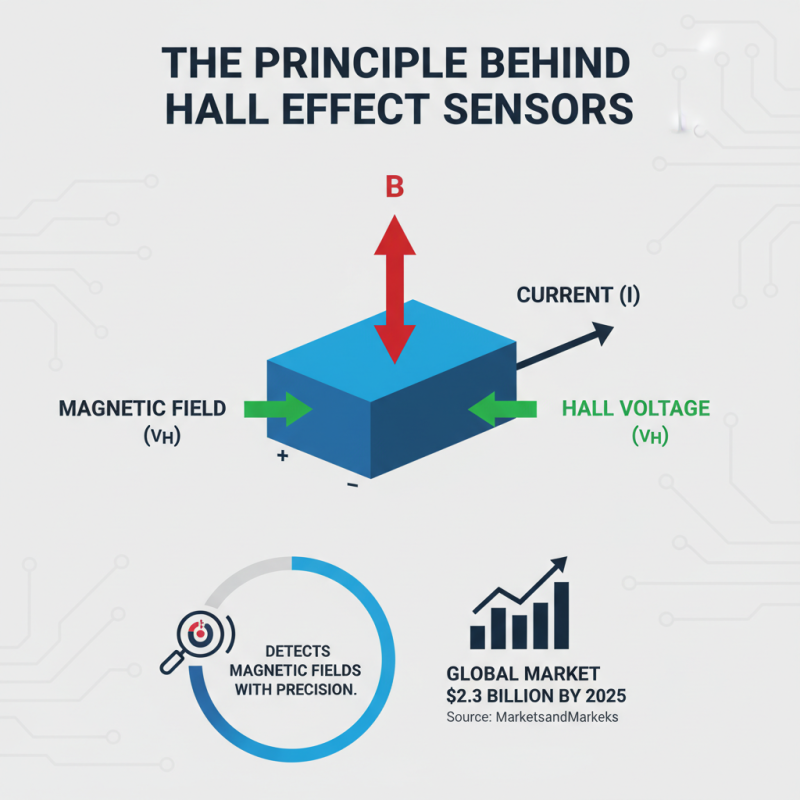
Hall effect sensors operate on a fascinating principle rooted in electromagnetic fields. When a conductor carries an electric current and is placed in a magnetic field, a voltage is generated perpendicular to both the current and the magnetic field. This phenomenon, known as the Hall effect, enables sensors to detect magnetic fields with excellent precision. According to a report by MarketsandMarkets, the global Hall effect sensor market is projected to reach $2.3 billion by 2025, highlighting the technology's increasing relevance in various applications.
These sensors find wide-ranging applications, including automotive systems and industrial automation. For instance, they can measure rotation speed, position, or proximity without direct contact. This non-contact nature reduces wear and tear, enhancing reliability. Nevertheless, potential challenges exist, such as sensitivity to external magnetic noise. Even minor fluctuations in magnetic fields can cause inaccuracies. Engineers must consider these aspects when designing systems that utilize Hall effect sensors.
Furthermore, the accuracy of these sensors is dependent on their calibration. Improper calibration can lead to significant errors in measurement. Regular checks are essential to ensure the sensors function accurately over time. While Hall effect sensors are robust, users should remain vigilant about potential limitations in high-noise environments. Balancing accuracy and environmental factors is crucial for optimal performance.
Types of Hall Effect Sensors and Their Applications
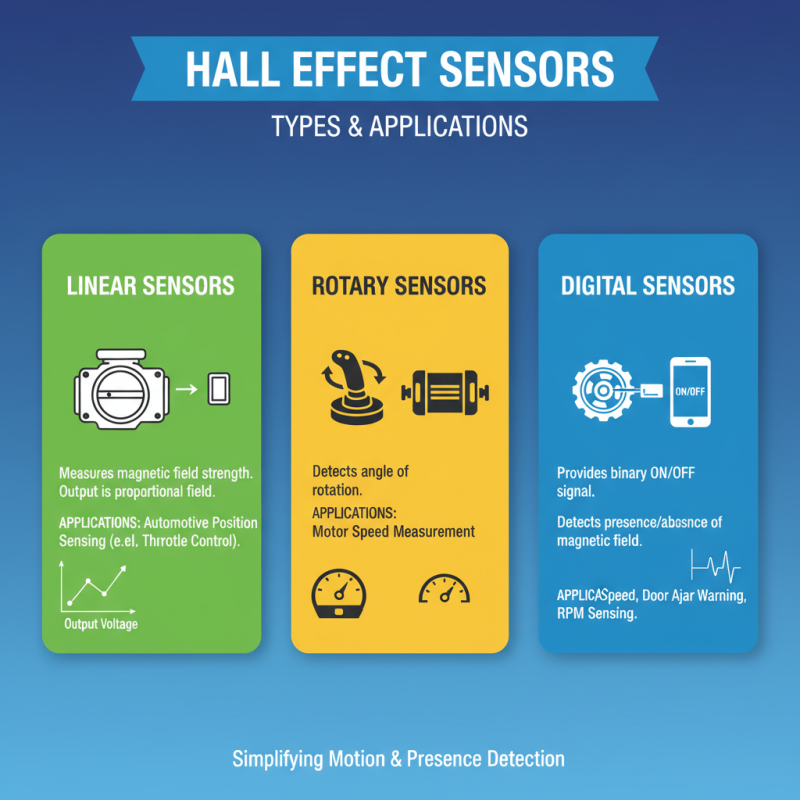
Hall Effect sensors come in various types, each tailored for specific applications. The most common types include linear, rotary, and digital sensors. Linear sensors measure the strength of a magnetic field, providing an output proportional to the field strength. These sensors find use in position sensing for automotive applications, like throttle control. Rotary sensors, on the other hand, detect the angle of rotation and are often utilized in joystick controls or to measure motor speed.
Digital Hall Effect sensors are used for binary applications, like detecting the presence of a magnetic field. They can be found in consumer electronics, such as smartphones, alerting users when the device is closed. Despite their advantages, Hall Effect sensors can face challenges. For example, they may be sensitive to changes in temperature or magnetic interference, which can impact accuracy.
Beyond these types, Hall Effect sensors are crucial in industrial automation. They monitor speed and position in conveyor systems. Yet, integrating them into existing systems might demand careful calibration and testing. It's essential to weigh their benefits against potential complications in unique applications. As technology evolves, the need for reliability and precision in Hall Effect sensors persists.
How Hall Effect Sensors Convert Magnetic Fields to Voltage
Hall Effect Sensors are fascinating devices that convert magnetic fields into electrical voltage. They operate based on the Hall effect, discovered by Edwin Hall in 1879. When a magnetic field is applied to a current-carrying conductor, a voltage appears perpendicular to both the current and the magnetic field. This voltage, known as Hall voltage, is what sensors utilize to detect the presence and strength of a magnetic field.
In practical applications, Hall Effect Sensors have a wide range. They are used in automotive systems to monitor engine position and speed. In industrial settings, they help detect angular position or proximity. However, the accuracy and reliability of these sensors can vary. Environmental factors, such as temperature and magnetic interference, may affect their performance. Understanding these limitations can enhance their application in real-world scenarios.
By measuring the Hall voltage, these sensors enable modern technologies to function efficiently. Yet, they may require calibration for optimal performance. Proper installation and awareness of potential interference are crucial for accuracy. Overall, the conversion of magnetic fields into a measurable voltage is a critical process in many devices we rely on daily.
Advantages and Limitations of Hall Effect Sensors
Hall Effect sensors offer several advantages. They are compact and lightweight, making them suitable for various applications. Additionally, they provide precise measurements in the presence of magnetic fields. These sensors function without physical contact, which reduces wear and tear. This durability is crucial in environments with high usage.
However, Hall Effect sensors also have limitations. Their performance can be affected by temperature variations. You may need specialized circuits for accurate readings. This can complicate the design process. Moreover, they can be sensitive to interference from other electronic devices. Such interference may lead to inaccurate data.
Understanding these pros and cons is vital. While Hall Effect sensors bring many benefits, their constraints must be acknowledged. Designers should carefully evaluate their applications. This ensures that the chosen sensor meets specific needs effectively. Balancing these factors can lead to improved outcomes in your projects.
What are Hall Effect Sensors and How Do They Work? - Advantages and Limitations of Hall Effect Sensors
| Aspect |
Details |
| Principle |
Utilizes the Hall effect, which occurs when a magnetic field is applied perpendicular to the flow of current in a conductor. |
| Key Components |
Hall element, magnet, and supporting circuitry. |
| Applications |
Position sensing, speed detection, and current sensing in various electronic devices. |
| Advantages |
Non-contact operation, high reliability, and durability in harsh environments. |
| Limitations |
Sensitivity to temperature changes and potential interference from other magnetic fields. |
| Types of Hall Effect Sensors |
Linear, digital, and latch type sensors. |
| Typical Output |
Analog voltage output for linear sensors and digital ON/OFF output for digital sensors. |