How to Choose the Right Ct Current Transformers for Your Application?
Choosing the right CT current transformers is crucial for efficient power management. The global current transformer market is projected to reach $2.7 billion by 2025, according to a recent industry report. Accurate selection impacts energy efficiency and system reliability, yet many users find this process daunting.
CT current transformers differ significantly in design and application. Understanding their specifications is key. For instance, the accuracy class can determine the performance of metering applications. Poorly chosen transformers can lead to energy loss and inaccurate measurements. This can be very costly for businesses.
Many industries overlook the importance of selecting the right CT current transformers. As technology evolves, maintaining awareness of the latest advancements is necessary. It's not just about costs; it’s about ensuring compliance and maximizing efficiency. The wrong choice may lead to regrets down the line. Effective decision-making in selecting CT current transformers requires careful consideration of multiple factors.

Factors to Consider When Selecting CT Current Transformers for Applications
When selecting CT current transformers, several factors come into play. The application determines the necessary specifications. Understanding the load type is essential. For instance, commercial buildings often require different transformers than industrial settings. Voltage levels, frequency ranges, and expected load currents must be considered.
Another key factor is accuracy. According to a recent report by the Institute of Electrical and Electronics Engineers (IEEE), a 1% accuracy rating can dramatically impact measurements in high-precision applications. A selection that appears suitable in one context may not perform optimally elsewhere.
**Tip:** Always check the transformer's efficiency rating. Models with a higher rating can save energy costs over time.
Insulation type is also crucial. There are various insulation materials that offer different levels of protection and durability. For extreme environments, options must resist humidity, dirt, and other factors that can lead to premature failure.
**Tip:** Look for units with multi-layer insulation. They provide better reliability and longevity.
When choosing CT current transformers, diving deep into application requirements can reveal potential shortcomings in available models. Engaging with professionals can clarify those challenging aspects.
Understanding the Different Types of CT Current Transformers Available
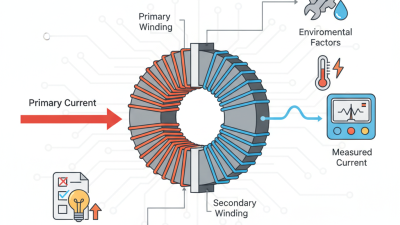
When choosing CT current transformers, understanding the various types available is crucial. Current transformers serve to measure electrical currents safely. There are two main types: wound and toroidal. Wound CTs are designed with windings on a magnetic core, while toroidal CTs encircle the conductor. Each type suits different applications and environments.
Wound CTs are often used for high current measurements. According to industry data, they are preferred where precision is vital. These transformers can handle larger amperage and provide higher accuracy. On the other hand, toroidal CTs are lightweight and easier to install. Their compact size makes them suitable for limited spaces.
Tips: Consider your application's current range. Select a CT that matches or exceeds your requirements. Assess installation space as well. Sometimes, a compact solution works wonders. You might find yourself puzzled between options. Don't rush; evaluate all specifications. The wrong choice can lead to faults or damage in the system. Think critically before making your selection.
Evaluating Voltage Levels and Frequency Specifications for CT Selection
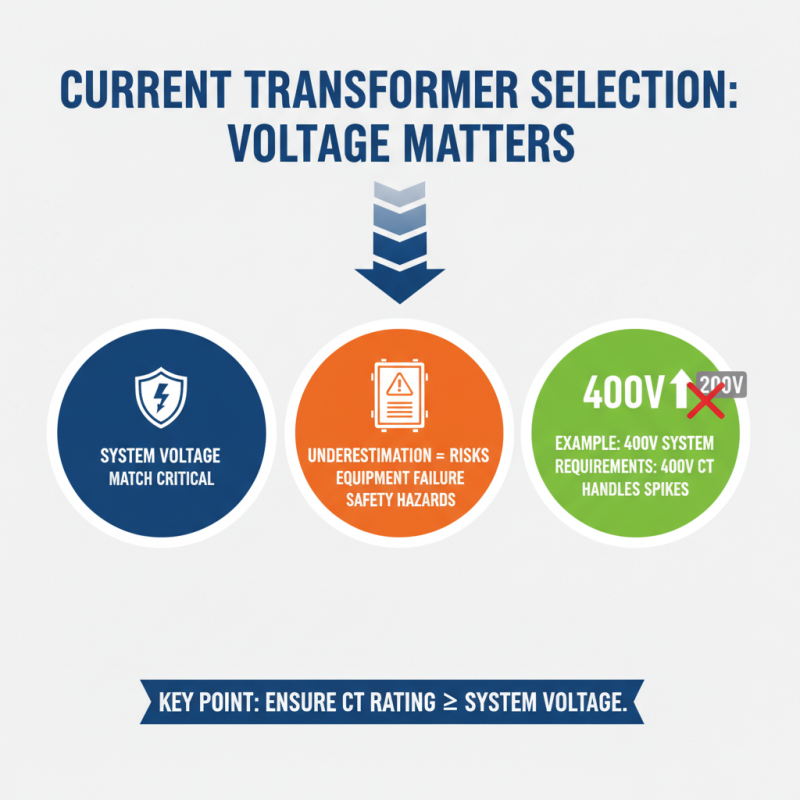
When selecting the right current transformer (CT), evaluating voltage levels is crucial. A CT must match the operational voltage of your system. Underestimating this can lead to equipment failure or safety risks. For example, a 400V system demands a transformer rated for that voltage. Lower specs may not handle spikes effectively.
Frequency is another essential factor. Most industries operate at 50Hz or 60Hz. But some applications might require different frequencies. A mismatch can affect the accuracy of current readings. Factors like harmonics can further complicate measurements in non-standard scenarios.
Ultimately, precision in voltage and frequency ensures reliability. It's not just about fitting a transformer; it’s about understanding your application’s needs. Often, engineers may overlook these details, leading to costly mistakes. Making informed choices means fully assessing your system's specifications.
Assessing Accuracy Class and Burden Ratings in Current Transformers
When choosing current transformers (CTs), understanding accuracy class and burden ratings is crucial. Accuracy class indicates how closely the transformer can replicate the primary current. A higher class means lower error margins. This matters in applications requiring precise measurements, like metering and protection schemes. Selecting the wrong class can lead to significant discrepancies.
Burden ratings define the load that a CT can support while maintaining accuracy. It's a measure of how much connected equipment can affect performance. A mismatch here could result in inaccurate readings. Sometimes, installers underestimate the burden, leading to operational issues later. For projects involving complex systems, this is especially important to consider.
In practice, measuring burdens can be challenging. Engineers may find it difficult to calculate the exact load needed. They often overlook factors like temperature variations and material changes. Accuracy and performance may decline without proper assessment. Thus, a thorough review of both accuracy class and burden ratings is vital for optimal performance in any application.
Industry Applications and Case Studies: Choosing the Right CT for Success
When selecting the right current transformer (CT), understanding the application is crucial. Many industries rely on CTs for monitoring electrical systems. For instance, renewable energy facilities use them to measure energy flowing from solar panels. A mismatch in CT specifications could lead to inaccurate readings. This can cause inefficiencies in energy production.
In manufacturing, CTs are common for monitoring motor performance. A poorly chosen CT may not capture all current variations. This could lead to equipment failures or increased maintenance costs. For commercial applications, accurate measurements are essential for billing purposes. An unsuitable CT could harm a business financially.
Case studies reveal the importance of matching CTs to specific needs. A utility company faced challenges due to incorrect CT ratings. They had to invest time and resources into correcting these mistakes. Learning from such cases can help others avoid similar pitfalls. A thoughtful selection process is key for success in any application.