How to Choose Hall Magnetic Sensors for Your Applications?
Choosing the right Hall Magnetic sensors for applications is crucial. Renowned expert Dr. Emily Carter, a leading figure in magnetic sensing technology, emphasizes, "Understanding the application is key to selecting the right sensor." This statement resonates deeply within the industry. The Hall Magnetic sensors are used in various fields, from automotive to consumer electronics. Their versatility hinges on precise application needs.
In selecting Hall Magnetic sensors, one must consider factors like sensitivity, temperature range, and size. Each application demands different specifications. Finding the right fit can be challenging. Engineers often face uncertainty when adapting these sensors to specific requirements. Experience plays a vital role in navigation through these complexities. The real-world implications of sensor choices can be significant, impacting efficiency and performance.
Misjudgments can lead to unexpected outcomes. For instance, selecting a sensor with inadequate sensitivity might result in failure to detect necessary magnetic fields. Hall Magnetic sensors are powerful tools, yet their effectiveness lies in the correct application. Adequate knowledge and careful evaluation make all the difference in ensuring optimal functionality and reliability in your projects.

Understanding Hall Magnetic Sensors and Their Operation Principles
Hall magnetic sensors are essential components in various applications, from automotive to consumer electronics. Understanding their operating principles is crucial for effective selection. These sensors work based on the Hall effect, which occurs when a magnetic field interacts with the electric current flowing through a conductor. This interaction generates a voltage perpendicular to both the current and the magnetic field.
Data from industry reports indicate that Hall sensors are highly efficient, offering precise measurements of magnetic fields with minimal energy consumption. Their sensitivity can reach as low as 1 mT, making them suitable for detecting small magnetic fluctuations. However, the environment in which these sensors operate can impact their performance. Temperature variations and electromagnetic interference can lead to inaccuracies. Additionally, choosing the right type—whether linear or latch—depends on the specific application requirements.
Many users overlook calibration, which is crucial for precision. Regular recalibration can reduce drift and enhance reliability. Despite being a mature technology, the variations in sensor designs pose challenges. Not all sensors handle high levels of magnetic flux well, which can cause saturation. Understanding these nuances can lead to better application outcomes and potentially avoid costly mistakes.
Key Factors to Consider When Selecting Hall Magnetic Sensors
When selecting Hall magnetic sensors, several key factors must be evaluated. Understanding your application's requirements is crucial. Consider the magnetic field strength, the sensitivity needed, and the sensor's operating temperature range. Different sensors perform better under different conditions.
**Tips:** Focus on the specific environment. Outdoor applications might require a different sensor than those used indoors.
Another important factor is the type of output signal. Hall sensors can provide analog or digital signals. Think about the integration of these outputs into your existing systems. Compatibility can save time and resources during development.
**Tips:** When unsure, consult data sheets. They provide valuable insights into signal types and performance metrics.
Finally, consider the physical dimensions and mounting options of the sensors. Some applications may require compact designs. Others may prioritize durability over size.
**Tips:** Prototype with different sizes to see what fits best. Testing is essential for optimal performance.
These considerations can shape your decision-making process and lead to effective sensor selection.
How to Choose Hall Magnetic Sensors for Your Applications? - Key Factors to Consider When Selecting Hall Magnetic Sensors
| Parameter |
Description |
Example Values |
| Sensing Type |
Indicates the magnetic field condition the sensor can detect. |
Linear, Latch, Switch |
| Output Type |
Defines the electrical output signal given by the sensor. |
Analog, Digital, PWM |
| Supply Voltage |
Operating voltage required to power the sensor. |
5V, 12V, 15V |
| Sensitivity |
Ability of the sensor to respond to a given magnetic field strength. |
10 mT/G, 100 mT/G |
| Temperature Range |
Operational temperature limits for the sensor. |
-40°C to 125°C |
| Response Time |
The time it takes for the sensor to respond to a magnetic field change. |
< 10 ms |
| Package Type |
Form factor and physical size of the sensor. |
SMD, TO-220, DIP |
Different Types of Hall Magnetic Sensors and Their Applications
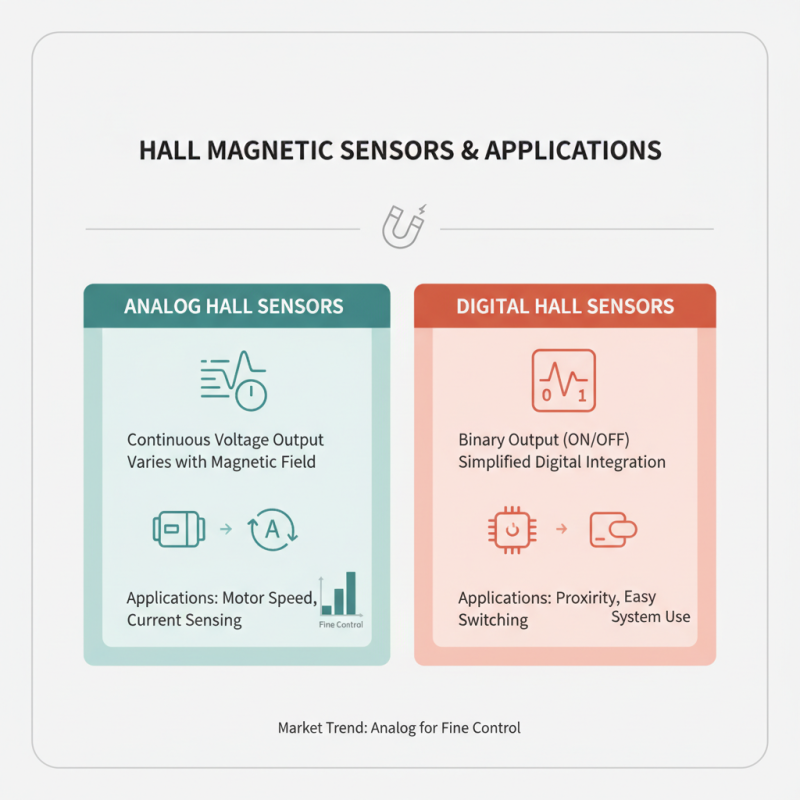
When selecting Hall magnetic sensors, it's crucial to understand the different types available. These sensors can be classified broadly into analog and digital types. Analog Hall sensors provide a continuous voltage output that varies with the magnetic field strength. This allows for precise measurements. On the other hand, digital Hall sensors deliver a binary output, simplifying integration into digital systems. According to a recent market analysis, analog sensors are favored in applications requiring fine control, such as motor speed monitoring and current sensing.
Magnetic sensors find diverse applications across multiple industries. For instance, automotive applications utilize Hall sensors for position detection in electric steering systems. The global automotive sensor market is projected to grow by over 6% annually. Industrial applications employ these sensors in robotics and automation for proximity sensing. However, the selection can be tricky. Each type has its limitations. For example, analog sensors can be susceptible to noise, affecting accuracy. Thus, a well-thought-out selection process considering environmental factors and specific application needs is essential for optimal performance.
Evaluating Environmental Considerations for Sensor Deployment
When deploying Hall magnetic sensors, environmental considerations play a crucial role. Different applications may expose sensors to varying conditions such as temperature, moisture, and magnetic interference. For instance, research indicates that temperature fluctuations can affect sensor accuracy. A study found that temperatures exceeding 85°C can reduce the lifespan of standard Hall sensors by nearly 20%.
Moisture is another critical factor. Sensors installed in humid environments may suffer from condensation-related issues. This can result in short circuits and erroneous readings. Moreover, physical factors such as vibration and shock must be considered. In high-vibration environments, the sensor's mounting and housing become vital for reliable performance.
Incorporating these factors requires careful evaluation. Manufacturers often rely on industry reports which suggest that about 30% of sensor failures are linked to improper installation or unsuitable environmental conditions. Regular testing in simulated conditions can improve reliability. Investing in environmental testing can prevent significant operational downtime.
Environmental Considerations for Hall Magnetic Sensors
Cost-Effectiveness and Sourcing Options for Hall Magnetic Sensors
When selecting Hall magnetic sensors, cost-effectiveness is critical. Understanding the pricing landscape helps in making informed decisions. Low-cost options may lack durability or precision. It's essential to balance price with performance for long-term use. In some cases, paying a higher initial cost can lead to reduced maintenance expenses later.
Sourcing options vary widely. Local suppliers can offer faster delivery and support. However, they may charge more. Conversely, international vendors often have competitive prices but longer shipping times. Assessing your project's urgency and budget is vital. Conducting thorough research on each supplier's reliability is necessary.
Sometimes, manufacturers provide bulk purchasing discounts. This can lead to significant savings, especially for large projects. Yet, committing to large quantities without testing can be risky. Testing sensors separately ensures quality before bulk orders. Balancing cost and reliability in sourcing will enhance the overall success of your application.